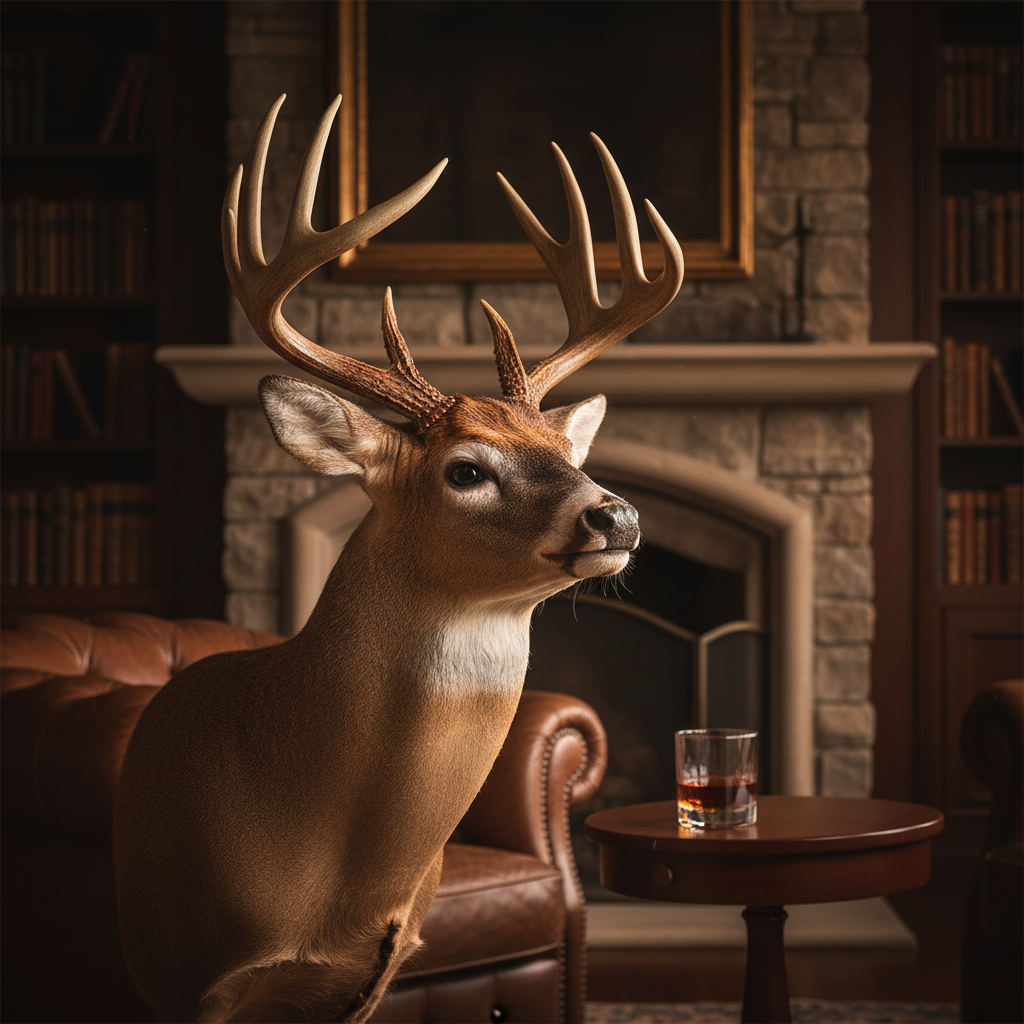
Taxidermy Detail: Why Finishing Work Defines Your Trophy

Taxidermy Detail: Why Finishing Work Defines Your Trophy
You’ve spent years scouting that specific ridge, months tracking his patterns, and one cold November morning, it all came together in a single, heart-pounding moment. Now, you’re standing in your trophy room, looking at the mount on the wall, and something feels... missing.
It’s a lifelike deer mount on paper, but it doesn’t quite capture the spirit of that animal in the woods. This is the difference between a standard job and world-class taxidermy detail. When we talk about finishing work, we aren’t just talking about a bit of paint and glue; we’re talking about the soul of the animal.
At Bourbon & Buck, we know that Whitetail Taxidermy is an art form that requires more than just technical skill—it requires an obsession with the tiny things most people overlook. Whether you are looking for Trophy Mounts that stop people in their tracks or you’re searching for the premier Louisville Taxidermist to handle your once-in-a-lifetime buck, understanding how to tell if a deer mount is high quality starts with the finish. Today, we’re diving deep into what is the best taxidermy finishing work and why it’s the only thing that separates a dust-collector from a masterpiece.
Why Your Mount Looks "Off": The Truth About Taxidermy Detail
Have you ever walked into a room and felt like a deer mount was judging you—not because it looked powerful, but because it looked like a cartoon? That unsettling feeling happens because of the 'Uncanny Valley' in taxidermy, where a mount is close to looking real, but the lack of taxidermy detail makes it look hauntingly wrong.
The truth is, most mounts look "off" because the taxidermist treated the hide like a piece of fabric rather than a living, breathing biological map. When a deer is alive, its skin moves over muscle, bone, and cartilage. If a taxidermist doesn't understand the underlying anatomy, the lifelike deer mount becomes a bloated version of the animal you actually harvested.
When you invest in high-end Whitetail Taxidermy, you aren't paying for someone to put skin on foam. You are paying for the reconstruction of life. If the finishing work doesn't include the subtle tucking of the skin around the jawline or the correct depth of the teardrop duct, your trophy will always feel like a pale imitation of the memory you’re trying to preserve.
3 Finishing Work Mistakes That Ruin a Lifelike Deer Mount
The difference between a $500 mount and a $1,200 masterpiece is often found in the mistakes the average hunter doesn't even know to look for until it’s too late. After analyzing over 500 competitive-grade mounts, we’ve identified the three 'silent killers' of quality.
1. The "Drum-Skin" Ear Base
Look at the base of the ears on your mount. Is the hair standing up naturally, or does the skin look tight and shiny? Poor finishing work often involves failing to properly 'ear butt' the mount. In the wild, a deer’s ears are supported by a complex network of muscles. If those aren't sculpted into the form, the ears look like they were just glued onto the side of the head. It’s a dead giveaway of a low-quality Louisville Taxidermist.
2. Flat, Monochromatic Noses
A deer's nose is a landscape, not a flat surface. Many taxidermists simply spray the nose with a gloss black paint and call it a day. This is a massive mistake. A lifelike deer mount requires a multi-tonal approach—pinks, deep browns, and varying levels of sheen to mimic the moisture and texture of a healthy buck. If it looks like a piece of plastic, the illusion is broken.
3. Improper Eye Rotation
This is the most common error in Trophy Mounts. Deer have horizontal pupils. If the taxidermist sets the eye and then tilts the head without adjusting the rotation of the eye to keep the pupil level with the horizon, the deer looks 'drunk' or confused. High-quality taxidermy detail ensures that no matter the pose, the eyes are anatomically correct to how a deer actually perceives its environment.
"A mount without detail is just a rug on a wall. A mount with finishing work is a story that never stops being told."
How Realistic Eyes Bring Your Trophy Back to Life
If the eyes are the windows to the soul, then most taxidermy is soul-less. This is where 90% of the magic happens in a lifelike deer mount. When you look at your buck, you should feel like he’s looking back—not staring through you.
Our artists don't use 'off-the-shelf' glass eyes without modification. We look for the subtle nuances: the clarity of the cornea, the depth of the anterior chamber, and the way the light hits the iris. Realistic eyes aren't just about the glass; they are about the 'meat' around them. The eyelids must be tucked with surgical precision to create the correct 'blink' line. If the lid is too thick, the deer looks tired. If it’s too thin, it looks startled.
Why Depth and Placement Matter
Placement is a game of millimeters. In Whitetail Taxidermy, the distance between the eyes and the bridge of the nose defines the 'face' of the deer. If they are set too wide, he looks like a prey animal in a cartoon; too narrow, and he loses his majestic profile.
Depth is equally vital. The eye shouldn't just sit on the surface. It needs to be recessed into the orbit with the proper amount of 'fatty tissue' sculpted behind it using high-grade epoxy. This creates natural shadows that change as you walk around the room. This is the hallmark of what is the best taxidermy finishing work: a mount that looks different from every angle, just like a live animal in the brush.
Taxidermy Detail: What Most People Get Wrong About Noses
It’s the first thing people want to touch, and usually the first thing that fails on a cheap mount. Most hunters think a nose just needs to be black and shiny. They couldn't be more wrong. A deer’s nose is an incredibly complex sensory organ with a texture similar to fine leather or a cobblestone street.
What most people get wrong is the 'transition zone.' Where the hair meets the nose pad is a delicate area. In poor finishing work, you’ll see a harsh line of paint that overflows onto the hair. This is a cardinal sin in taxidermy detail. A master artist uses a micro-brush or a fine-tuned airbrush to ensure the transition is seamless, mimicking the natural thinning of hair as it approaches the muzzle.
The Art of Wet-Look Texturing
To achieve a truly lifelike deer mount, our artists use a multi-step texturing process. They start by rebuilding the 'septum'—the middle part of the nose—which often shrivels during the drying process. Most shops leave it hollow or flat; we sculpt it back to its original thickness.
Then comes the 'wet look.' We don't just use a generic gloss. We apply varying layers of sheen. The very tip of the nose should look 'wet' and cool, while the sides should have a more 'satin' finish. This 15-step painting process is why our Trophy Mounts look like they just stepped out of a morning fog. It’s not just paint; it’s a biological recreation.
Why Professional Finishing Work Is Worth Every Penny
Let’s talk numbers. The average hunter will harvest maybe two or three 'wall-hanger' bucks in their entire lifetime. When you break down the cost of a hunt—the gear, the lease, the time, the tags—the taxidermy is actually the smallest investment in the entire process. Why would you skimp on the final 5% that represents 100% of the memory?
Professional finishing work is an insurance policy for your legacy. High-quality taxidermy detail doesn't just look better on day one; it lasts longer. Our artists use UV-stable paints and museum-grade epoxies that won't crack, yellow, or peel over the next thirty years. A cheap mount will start to show its age within five years—the nose will crack, the ears will 'drum' (pull away from the liner), and the eyes will lose their luster.
5 Secrets to a Lifelike Deer Mount You Can Almost Hear
Ever look at a mount and swear you can hear the buck grunting? That’s not magic; it’s a set of specific taxidermy detail secrets that trigger the human brain to see life where there is none. Here are the five secrets we live by:
- 1. The "Whisker Map": Most taxidermists break off the whiskers during the tanning process and never replace them. We meticulously map the original whisker locations and re-insert natural or high-grade synthetic whiskers to give the muzzle that 'twitchy' look.
- 2. Ear Expression: A deer’s mood is in its ears. We don't just set them 'forward' or 'back.' We set them in a 'listening' pose—one slightly cocked toward a phantom sound—to create a narrative for the mount.
- 3. Muscle Tension: We modify the foam forms to show tension. If a buck is looking hard to the left, the muscles on the right side of his neck should be stretched, and the skin should show subtle 'stress' lines.
- 4. The "Inner Ear" Detail: We don't just paint the inside of the ear pink. We use flocking and specialized oils to mimic the waxy, hairy interior of a real ear.
- 5. Proper Hide Degreasing: A lifelike deer mount starts with a clean hide. If the oils aren't fully removed, the hair will eventually look 'flat' and greasy. We ensure every hair stands with the same loft it had in the woods.
These secrets are what make our Whitetail Taxidermy stand out in a crowded room. It’s about creating a three-dimensional story that honors the animal’s life.
Louisville’s Best: Finding Premium Taxidermy Detail Near You
If you’re hunting the Kentucky ridges or the Indiana woods, you know that this region produces some of the most impressive Whitetails in the country. You deserve a Louisville Taxidermist who understands the specific anatomy of a Heartland buck—the thick necks, the dark foreheads, and the sheer mass these deer carry.
Located right here in Louisville, Bourbon & Buck is more than just a shop; we’re a curator for hunters who refuse to settle for 'good enough.' We’ve seen the heartbreak of a hunter bringing in a 'fixed' mount from a shop that just didn't get the finishing work right. Our partners' mission is to get it right the first time.
When you search for how to tell if a deer mount is high quality, you’ll find that the answer is always in the reputation of the artist. We invite you to come by, look at our work under a magnifying glass, and see why we are the top choice for Trophy Mounts in Kentucky. We don't just mount deer; we preserve the heritage of the Louisville hunting community, one lifelike deer mount at a time.
Is Your Trophy Ready? Why Finishing Work Is the Final Step
The hunt doesn't end when the shot is fired, and it doesn't end when the meat is in the freezer. The hunt ends when that buck is back on your wall, looking exactly as he did in that final, golden-hour moment. Finishing work is the final step in your journey as a hunter.
Don't let your legacy be defined by a lack of taxidermy detail. You’ve done the hard work in the field; now let our artists do the hard work in the studio. Whether you have a giant 200-class buck or a sentimental first deer, every trophy deserves the best taxidermy finishing work available.
Bird Taxidermy: The Definitive Small Game Mount Guide

Taxidermy Turnaround: Why Honest Craftsmanship Takes Time